Join us at Spark 2026 - Nozomi Networks' Customer Conference!
Sign Up
INDUSTRY
With their imperative to transport passengers and cargo safely and on-time, airports and airlines are prime targets for threat actors. Pervasive IT/OT/IoT convergence means a cyberattack on any connected system can trigger cascading failures, degrading essential services and causing operational shutdowns.
Achieve operational resilience, meet compliance requirements and reduce cyber-physical risk with real-time context, OT/IoT-specific security controls and measurable resilience across all operational systems.

Some of the largest airports in the world rely on Nozomi Networks to keep their operations reliable and secure.
See how we helped a Top Five global airport improve visibility and security with real-time insights into OT/IoT vulnerabilities to quickly address cyber and operational risks.
From baggage handling and passenger screening to approach lighting and instrument landing systems, OT and IoT networks play a crucial role in ensuring the safety, efficiency and reliability of airport operations. A single terminal may have thousands of connected OT and IoT devices – many if not most of them unmanaged.
.avif)
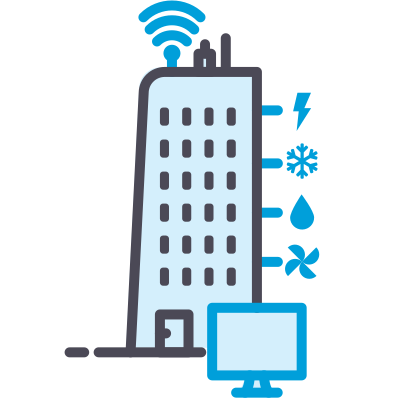
Terminal buildings & supporting infrastructure
Airport terminals have the same BMS challenges as other smart buildings – but on a much larger scale. Add to that power grids, water and wastewater systems, autonomous trains, traffic management and parking control.

Baggage handling systems that cannot fail
Mission-critical BHS sit at the intersection of operational continuity, passenger experience, safety and revenue. Few systems can cause instant, visible and cascading disruption as quickly as a BHS failure.

Perimeter security & security checkpoints
Passport control, kiosks, baggage scanners, CCTV and other physical security devices and their communications must function flawlessly to ensure smooth security checks and passenger safety.
Display boards, sensors & other IoT devices
Ubiquitous IoT systems are connected to a variety of otherwise secure networks, often wirelessly, and lack basic cybersecurity hygiene, which makes them easy to compromise.

With the rapid pace of digitalization, regulations may not keep up with the emerging cyber risks. Aviation-sector organizations need to ensure their cyber risk posture and efforts extend beyond compliance, towards a holistic risk management approach.
As critical infrastructure, aviation is among the most heavily regulated sectors globally. OT and IoT assets are typically outside of IT cybersecurity plans, but they’re subject to inclusive regulatory frameworks and corporate cybersecurity standards.
In addition to the NIS2 Directive, EASA Part-IS in the EU and the TSA Security Directives and Emergency Amendments in the U.S. and are the most challenging. Arguably the most stringent aviation cyber regulation, EASA Part IS increasingly serves as the global benchmark. The Nozomi platform helps aviation organizations meet these and other requirements.

The European Union Aviation Safety Agency (EASA) Part-IS requires stakeholders across the aviation sector to protect all safety-critical systems, including OT and IoT, from cyber and information threats through:
The Transportation Security Administration (TSA) Security Directives for Aviation require:
The Nozomi platform helps aviation organizations comply with regulations and keep airplanes flying by providing a complete, accurate inventory of OT and IoT assets, risk-based vulnerability management, network segmentation validation and continuous security monitoring to detect and respond to the threats and anomalies that matter most.

Gain context with unparalleled asset visibility and vulnerability management built on the broadest range of wired, wireless and endpoint sensors with AI-enriched profiles.

Nozomi Networks’ flexible, scalable architecture and integrations make it easy to tailor our solution for any airport environment.



.svg)