Cybersecurity has become a strategic imperative for critical infrastructure operators worldwide, and India's power sector is no exception. With the publication of the Central Electricity Authority (Cyber Security in Power Sector) Regulations, 2026, the Indian government has introduced one of the most comprehensive cybersecurity compliance frameworks ever applied to the country's electricity ecosystem. The regulations come into force on 1 April 2027 and apply to generation, transmission, distribution, load dispatch, energy storage and other critical power-sector entities. with specific obligations extending to vendors and service providers as well.
For chief information security officers (CISOs), IT security managers and operational technology (OT) managers, these regulations represent far more than a compliance exercise. They establish a formal expectation that cybersecurity become an operational discipline embedded into every stage of power generation, transmission and distribution.
The challenge for many organisations is that compliance cannot be achieved through policies alone. The regulations require visibility, monitoring, governance, asset management, risk assessment, incident response and supply chain controls that span both IT and OT environments.
What Makes the CEA Cyber Regulations Significant?
The new framework brings together many cybersecurity practices that have historically been implemented inconsistently across the power sector and transforms them into regulatory requirements.
Among the key mandates are:
- Appointment of a CISO and an alternate CISO.
- Establishment of a dedicated Information Security Division operating within India
- Development and annual review of a Cyber Security Policy
- Creation of a Cyber Crisis Management Plan
- Annual cybersecurity audits covering critical systems
- Comprehensive cyber asset registers and risk assessments
- Continuous monitoring of IT and OT environments.
- Structured incident response and reporting processes
- Security requirements for vendors and supply chains
- Procurement of equipment and services from approved or trusted sources
Perhaps most importantly, the regulations explicitly recognise the unique role of OT systems in power operations and introduce dedicated requirements for securing industrial control systems, communications infrastructure and operational networks.
OT Security Moves to Centre Stage
Many traditional cybersecurity programmes have focused primarily on enterprise IT systems. However, threat actors increasingly target control networks, substations, generation facilities and industrial communication systems because of their direct impact on operations.
The CEA regulations directly address this reality.
Entities operating OT environments must physically isolate OT systems from the internet and, wherever possible, from corporate IT systems. Where business requirements make connectivity unavoidable, organisations must implement hardened logical separation, risk assessments, approval processes and continuous monitoring.
The regulations further require:
- Dedicated communication channels for operational data
- Monitoring of OT-specific protocols and traffic
- Segmentation of OT environments into different trust levels
- Protection of communications between operational entities
- Strong controls around remote operation and remote access
- Security assessments prior to commissioning critical systems
For OT managers, this represents a clear shift toward defence-in-depth architectures that provide visibility across operational networks while preserving system availability and safety.
Governance and Accountability Reach Executive Level
One of the most notable aspects of the regulations is the emphasis on executive accountability.
The regulations require every covered entity to designate a senior-level CISO whose responsibilities are focused exclusively on cybersecurity matters. The CISO must oversee policy implementation, risk management, incident reporting, threat intelligence activities, audit remediation and regulatory compliance. Cybersecurity incidents must generally be reported to the Computer Security Incident Response Team-Power (CSIRT-Power) and CERT-In within six hours.
This elevates cybersecurity from a technical function to a board-level governance responsibility.
For CISOs, the message is clear: regulators now expect demonstrable oversight, measurable security controls and repeatable governance processes. Organisations that rely on informal practices or manual record keeping may struggle to prove compliance when auditors review their programmes.
Asset Visibility Becomes a Regulatory Requirement
A recurring theme throughout the regulations is visibility.
Entities are required to maintain detailed cyber asset registers, classify critical systems, document network architectures, identify communication protocols and continuously assess cyber risks associated with those assets. Organisations must also maintain risk assessment and mitigation plans and periodically update them.
This requirement creates a significant challenge for power operators that have accumulated industrial assets over many years, often across multiple sites and business units.
Many organisations still lack a complete inventory of OT assets, firmware versions, communication pathways and externally connected devices. Without this information, compliance becomes difficult and cyber risk remains poorly understood.
A mature OT visibility programme can help operators establish and maintain the level of asset intelligence required by the regulations while simultaneously supporting vulnerability management, network segmentation and incident response.
Supply Chain Security Receives New Attention
The CEA cyber regulations also place substantial responsibilities on vendors.
Suppliers must provide software updates, security patches, recovery procedures, bills of materials, lifecycle information, vulnerability disclosure processes and evidence that products are securely configured prior to deployment. Power sector entities must incorporate cybersecurity requirements into service agreements and perform appropriate risk assessments for vendors that have access to critical systems.
This reflects a growing global recognition that supply chain compromise remains one of the most significant threats facing critical infrastructure.
For procurement and security teams, cybersecurity can no longer be treated as a post-purchase consideration. Vendor risk management must become an integral component of operational resilience.
How Security Platforms Can Help Enable Compliance
Technology alone does not create compliance. However, achieving many of the requirements outlined by the CEA becomes considerably more difficult without effective visibility and monitoring capabilities.
Security platforms that provide OT and industrial cybersecurity capabilities can support organisations in several areas:
Asset Discovery and Inventory
Automated discovery can help maintain asset registers, identify unmanaged devices and document communications across complex industrial environments.
OT Network Visibility
Continuous monitoring enables organisations to understand operational communications, validate segmentation strategies and identify unauthorised connections.
Vulnerability Management
Visibility into firmware versions, software components and system configurations can assist teams in identifying vulnerabilities and prioritising risk reduction activities.
Threat Detection
Continuous monitoring can help detect threats including anomalous behaviour, suspicious communications and indicators of compromise affecting both IT and OT environments.
Incident Investigation and Response
Detailed asset context and network telemetry can accelerate investigations, support root-cause analysis and assist organisations in meeting reporting requirements.
Compliance Evidence
Security monitoring and asset visibility platforms can provide the operational evidence needed to support audits, risk assessments and governance reviews.
For organisations seeking to strengthen cyber resilience while preparing for 2027, these capabilities can help close the gap between policy requirements and operational execution.
A Practical Roadmap to April 2027 Cyber Security in Power Deadline… Starting Today
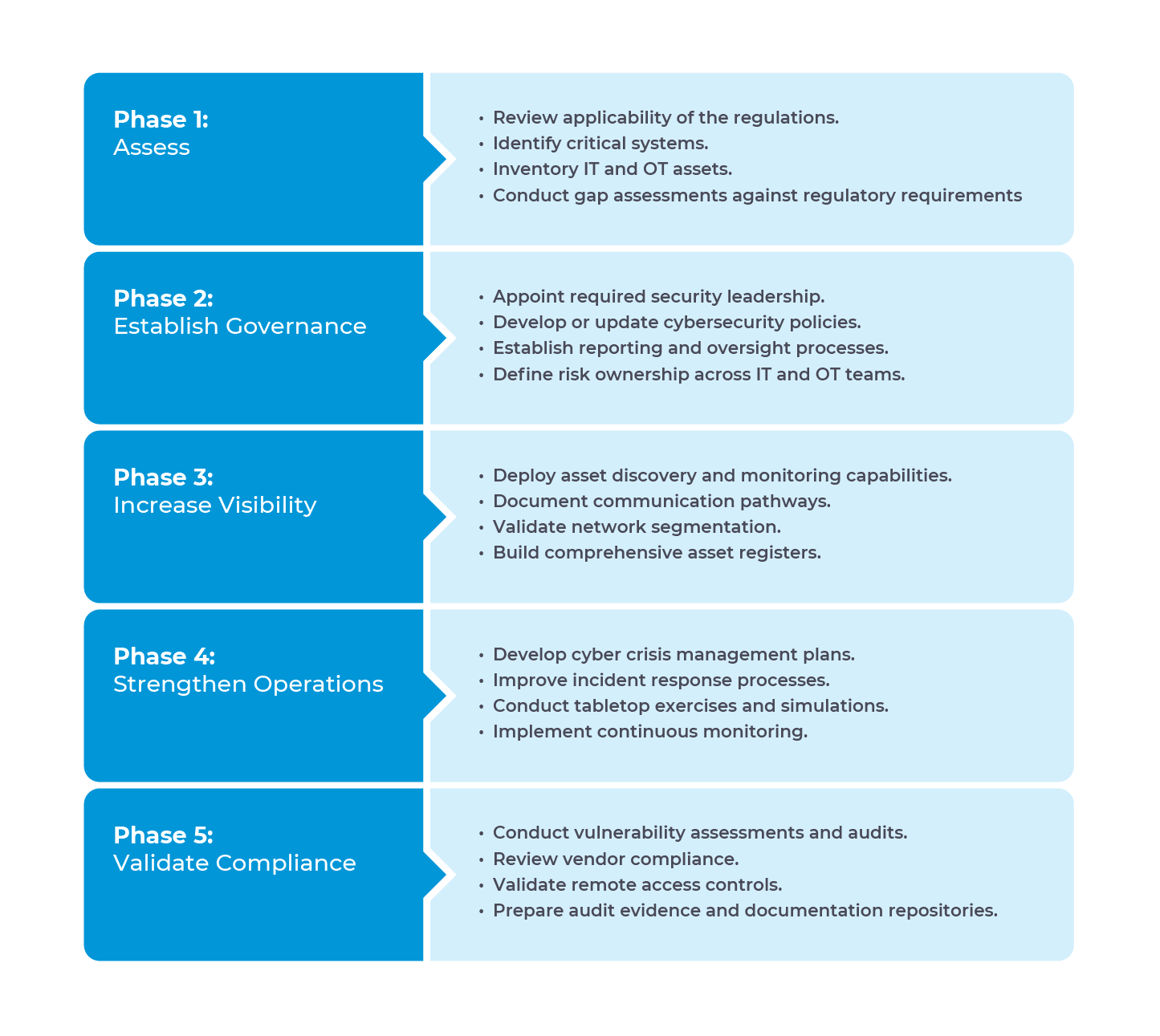
Power sector organisations should view the period before implementing their cybersecurity program and platform as an opportunity to build sustainable capabilities rather than rushing toward a compliance deadline. That being said, as of this writing there are only six months to accomplish that. Here ‘s a roadmap of suggested activities separated into five phases.
Compliance Checklist
Before April 2027, power sector operators should ensure they can answer "yes" to the following questions:
.webp)
A New Era of Cybersecurity Compliance for India's Power Sector
The CEA Cyber Security Regulations represent a significant evolution in India's approach to protecting critical energy infrastructure. Rather than focusing narrowly on compliance, the regulations encourage organisations to build long-term cyber resilience across both IT and OT environments.
For CISOs, IT security managers and OT managers, the next 18 months should be viewed as a strategic window to strengthen governance, improve asset visibility, modernise monitoring capabilities and establish operational resilience standards that will remain valuable long after the compliance deadline has passed. Organisations that begin now will be better positioned not only for regulatory compliance but also for the evolving cyber threat landscape facing the power sector.
Nozomi Is Here to Help You
Standing up a cybersecurity program that meets rigorous energy sector requirements is challenging, even if you have an experienced team. Nozomi Networks has helped hundreds of power operators worldwide meet the toughest requirements, including the NERC CIP Reliability Standards for North America. We employ many former asset owners who have implemented their own cybersecurity programs for power utilities. And if you’d like to walk through how to meet the April 2027 deadline while also building a sustainable program, reach out. We’re here to support you.
Looking for a practical roadmap to CEA compliance and cyber resilience? Join our upcoming webinar for expert insights and actionable guidance. Register now.